


Wingspan: The Board Game
Monster Couch sp. z o.o.
I approached Wingspan: The Board Game as someone who enjoys thoughtful board games but does not always have a table, a full group, or the patience to learn a rulebook in one sitting. This digital adaptation turns bird collecting into a calm strategy experience, yet it is much more than a relaxing theme placed over simple choices. Every turn asks me to decide whether to gather food, lay eggs, or attract another bird, and those choices gradually shape an engine that feels personal rather than mechanical.
The game is published by Monster Couch sp. z o.o. and sits in the board-game category. It is aimed at everyone, runs on Android from version 7.1 onward, and costs $9.99 before considering its optional in-app purchases, which range from $4.99 to $44.99 per item. That makes it a paid game with additional content to consider, so I would not recommend installing it casually without understanding the model. Still, the core experience has enough depth to justify attention if you like strategic games that reward planning instead of quick reactions.
What to expect when you begin
The first thing I noticed is the pace. This is not a game about tapping rapidly or reacting to a timer. It gives me room to inspect birds, think about their abilities, and choose a direction for the round. The presentation supports that mood with a nature-focused setting, but the decisions remain meaningful. A bird that looks useful now may be less valuable later if it demands food I cannot reliably produce or occupies a habitat I need for another purpose.
The premise is easy to understand: I build a wildlife preserve by placing birds into habitats, then use those birds to improve my future actions. The three main habitats serve different purposes. One helps me collect food, another helps me lay eggs, and the third helps me draw and play more birds. That division gives the game a clear rhythm. I am not simply collecting attractive cards; I am building a small system in which one action makes the next action stronger.
For a first-time player, the most important expectation is that early turns can feel modest. I may spend an action gaining a small amount of food or placing a single bird, and the result may not look impressive immediately. The satisfaction arrives when a later turn lets me activate several useful effects together. The real first victory is understanding how one bird can make an entire habitat more productive.
Related News






The game supports one to five players, so it can fit several different situations. I can use it as a quiet solo strategy game, introduce it to a friend, or bring it to a larger group that already enjoys board games. The experience changes with the number of players. In a solo session, I can concentrate on improving my own plan. With other people, the available cards and shared choices create more pressure, because a bird I am considering may disappear before my next turn.
Its average rating is 4.6 from around 9.6K ratings, and the game has passed 100K installs. Those figures suggest that it has found a committed audience, but they should not be mistaken for proof that everyone will enjoy it. I think the strongest audience is made up of players who like card combinations, gradual improvement, and decisions with delayed rewards. Someone looking for a fast party game or a purely decorative bird collection will probably find the experience slower and more demanding than expected.
How the first setup feels
My advice is to begin with the tutorial or the most guided learning option available rather than jumping straight into an ambitious match. The rules are not impossible, but several details matter at once: habitat placement, food costs, egg limits, bird powers, end-of-round goals, and the value of keeping cards for later. Learning all of that through a competitive game can make the opening feel more confusing than it needs to be.
Gallery
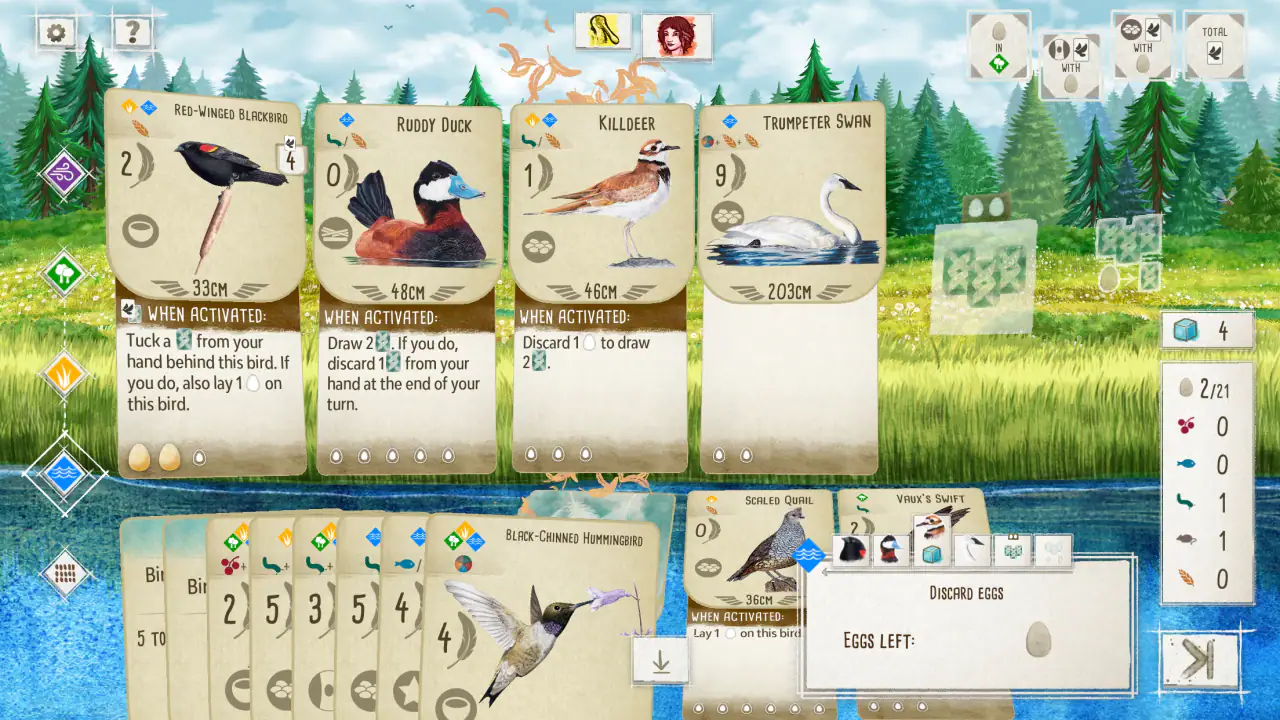
During setup, I try to read each bird card instead of selecting only by name or illustration. The useful question is not “Which bird is strongest?” but “Which bird fits the resources I can actually produce?” A powerful card that requires several different food types may sit unused if my food habitat is weak. A less dramatic bird with an easy cost can be better because it starts generating value sooner.
I also avoid filling my hand with too many attractive possibilities. Holding cards feels safe, but cards do not help until I can pay for and place them. In the opening, I prefer a compact plan: choose one or two birds that support the habitat I want to develop, then make the resources needed to play them. This reduces the feeling of being pulled in several directions at once.
The interface is easier to understand after I identify the action buttons as parts of a sequence rather than isolated commands. I select a habitat, perform its basic action, and then watch for the birds in that row to activate. That activation chain is the heart of the game. At first, it may seem as though I am only collecting food or eggs. After a few birds are installed, the same action can trigger several effects, and the board starts to explain itself.
A useful setup habit is to inspect the objectives before committing to a long-term plan. They can change what “good progress” means in a particular game. If an objective rewards a certain arrangement or type of bird, I may accept a slightly less efficient card because it helps with the broader scoring plan. I do not chase every objective blindly, though. A goal that forces me to abandon a strong engine can cost more than it returns.
The first successful action that changes the game
For me, the first meaningful success comes from creating a simple action loop. I might place a bird that improves food production, then use that habitat to gather enough food for a second bird. Once the second bird is active, the same action becomes more rewarding. This is the point where the game stops feeling like a sequence of small expenses and starts feeling like a working preserve.
New players often wait for a perfect hand before acting. I think that is a mistake. The best opening is usually not the most spectacular one; it is the one that lets me take a useful action repeatedly. If I can make food consistently, I can play birds. If I can lay eggs consistently, I can support more birds and satisfy certain scoring needs. If I can draw cards efficiently, I can search for a better fit instead of accepting the first option.
One of my favorite early decisions is choosing whether to improve the habitat I already use or repair a weakness elsewhere. If my food supply is poor, I may be tempted to keep gathering food until the problem disappears. But if my bird habitat cannot hold useful cards or my egg supply is too limited, that food may not convert into progress. I try to ask what resource is blocking my next two actions, not just what resource is lowest right now.
Eggs deserve special attention because they can look like a passive resource while quietly becoming a bottleneck. A bird may be excellent, but if the habitat has no room for eggs, I cannot take full advantage of the engine. I therefore avoid spending every egg immediately when I know a later bird or objective will need them. This is a small planning detail, but it often separates a smooth midgame from a series of frustrating capacity problems.
Another practical tip is to treat card powers as timing tools. I do not activate a bird merely because I can. Sometimes it is better to wait until I have enough space, food, or cards for the effect to matter. A draw effect used too early may give me more choices than I can afford. The same effect used after I have prepared the right habitat can provide the exact card needed to complete a scoring plan.
When I finish a first round with a modest but functioning engine, I consider that a success even if the score is not impressive. The important lesson is that the board rewards preparation. I am learning to turn one action into several benefits, and that understanding transfers directly into later games.
Where first-time players usually get confused
The biggest source of confusion is the difference between immediate value and future value. A bird with a high point value can be tempting, but playing it may consume food that would have enabled two cheaper birds. In contrast, a low-point bird with a useful power can improve several later turns. I now judge a bird by its cost, placement, power, and how many opportunities it creates, rather than by its printed points alone.
Another common mistake is treating all habitats as equally urgent. They are connected, but they do not solve the same problem. Food helps me play birds, eggs help me expand and support scoring, and the bird-drawing habitat helps me find options. If I spend every action in one habitat, I may create a strong local engine while leaving the rest of the preserve unable to use it. I try to build a basic balance first, then specialize when the cards give me a reason.
It is also easy to misunderstand the value of passing time. A round ending changes the available actions and can affect how much room I have to complete a plan. I do not want to spend every turn preparing for a perfect final move that never arrives. When the round is approaching its end, I shift from “What would be ideal?” to “What can produce points or resources before this opportunity disappears?”
Players coming from lighter board games may expect every attractive bird to be worth taking. In Wingspan, a card can be good in isolation and still be wrong for the current board. I have learned to reject birds more often. If the cost is awkward, the habitat is full, or the power does not connect with my existing plan, leaving the card behind can be the better decision. That restraint is one of the game's less obvious skills.
The opposite problem affects experienced strategy players: overplanning. It is possible to spend too much time calculating a chain that depends on several cards appearing in the right order. The available choices are not fully under my control, so I prefer flexible plans with a clear primary action and a backup. This keeps the game thoughtful without turning every turn into a long spreadsheet exercise.
There is also a learning curve around reading bird powers quickly. At first, I pause frequently to interpret wording and check how an effect fits the current turn. That is normal. With practice, I begin scanning for a few practical categories: food generation, egg production, card access, movement of resources, and scoring support. I do not need to memorize every bird. I only need to recognize which effects solve my current problem.
How it compares with familiar board-game alternatives
Compared with a traditional physical board game, the digital version removes much of the setup and bookkeeping. I do not need to arrange cards, track resources manually, or remember every triggered effect. That makes it especially convenient for a short evening session at home. The trade-off is that the screen can hide the structure that would be obvious on a table. I sometimes need to pause and inspect the board to understand why a habitat is producing more than expected.
Compared with lighter digital board games, this one asks for more patience. It does not deliver its best moments through constant rewards or rapid turns. Its pleasure comes from seeing a plan mature. If I want a game to play while distracted, I would choose something simpler. If I want a focused game that gives me room to reconsider my priorities, this is a better match.
It also differs from purely competitive strategy games because its theme softens the pressure without removing it. The birds make the board inviting, but the underlying decisions remain serious. A player who likes calm presentation but still wants meaningful trade-offs may appreciate that balance. Someone who prefers direct conflict, aggressive attacks, or dramatic reversals may find the interaction too indirect.
The one-to-five-player range gives it flexibility, but the ideal choice depends on what I want from the session. Solo play suits experimentation and careful planning. A small group makes card availability and timing more important. A larger group can create more waiting between turns, especially when everyone studies several possibilities. I would choose a smaller player count when introducing the game to someone new, because it leaves more space to explain decisions without making the session feel crowded.
Practical situations where it works well
I find it particularly useful for a quiet evening when I want something more engaging than a casual puzzle but less exhausting than a highly competitive game. I can play slowly, examine the available birds, and make a plan without needing perfect reflexes. It also works well as a digital substitute when friends are interested in the board game but cannot meet around the same table.
For a first session with a friend, I would suggest agreeing that the goal is learning rather than winning. Explain the three habitats, encourage the other player to ask why a move matters, and avoid correcting every inefficient choice. The game becomes much more approachable when the new player sees one small engine work. After that, the scoring and objectives make more sense because they are connected to something already visible on the board.
For solo practice, I recommend focusing on one skill per game. In one session, I might practice building a reliable food habitat. In another, I might prioritize egg capacity or card access. This is more useful than trying to optimize everything at once. It also makes losses informative: I can identify whether the problem was poor resource conversion, weak timing, or an overly ambitious objective.
The game is less suitable for children who need very simple rules despite its Everyone rating. The age label means the content is broadly accessible, but the strategic reading and delayed rewards may still be demanding for younger players. I would introduce it to a child who already enjoys turn-based board games, using the first match as a guided lesson rather than expecting immediate independent play.
Players should also think about the purchase before committing. The base price is $9.99, while optional items can cost between $4.99 and $44.99 each. I would treat the initial purchase as a deliberate choice and review any additional content separately rather than assuming every available item is necessary. If I only want a free, instantly accessible pastime, this is not the right recommendation. Its value depends on whether I will return to a slower strategy game often enough to justify paying for it.
What I would do after the first game
After completing a first match, I would not immediately chase the highest score. I would look back at the moments when my board stalled. Did I lack food because I delayed that habitat too long? Did I draw too many cards instead of playing them? Did I fill a habitat with birds whose powers did not work together? These questions reveal more than the final score and give me a concrete target for the next attempt.
My next step would be to choose a simple engine theme and commit earlier. For example, I might prioritize birds that make food easier to obtain, then select later birds that benefit from that reliable supply. The goal is not to force a particular combination every time. It is to notice how much smoother the game feels when the second half of the plan is supported by the first.
I would also experiment with taking fewer cards and playing them sooner. New players often confuse possibility with progress. A hand full of promising birds feels productive, but an active bird is what changes the board. Keeping only cards that fit the current plan makes decisions faster and reduces the disappointment of watching good options remain unused.
Once the basic flow feels comfortable, I would pay closer attention to end-of-round objectives and bird placement. These details add a second layer to the game: I am no longer just building an engine, I am shaping it toward a scoring target. The best move may therefore be slightly less efficient in the short term if it completes a useful objective or creates a stronger final position.
The current version is 1.8.998, and the game has been available since Nov 3, 2021. I mention that because it feels like a mature digital board-game adaptation rather than an experimental release. My experience is still shaped by the specific device and player group, but the overall design has enough structure to support repeated sessions instead of being a one-time tutorial.
In the end, I recommend Wingspan to anyone who wants a board game that feels peaceful without becoming empty. I like that it gives me time to think, rewards a plan that develops gradually, and makes the birds part of the strategy rather than mere decoration. I would skip it if I needed instant action, direct confrontation, or a completely free experience. For everyone else, the best way in is simple: learn one habitat at a time, build a small working engine, and let the first successful chain of actions show you why this game has earned its audience.
FAQs for Wingspan: The Board Game
What is Wingspan: The Board Game?
Wingspan: The Board Game is a digital adaptation of the popular bird-collection strategy board game. You build and manage a wildlife preserve by playing bird cards, collecting food, laying eggs, and creating habitats that support different species. The app keeps the original game’s strategic depth while adding automated rules, visual animations, and a convenient way to play without setting up a physical board.
How does the gameplay work in Wingspan?
Each round, you take a limited number of actions to develop three habitats: forest, grassland, and wetland. These habitats help you gain food, lay eggs, and draw or play bird cards. Every bird has different abilities, costs, and habitat requirements, so successful play involves planning combinations and balancing short-term rewards with long-term goals. Points come from birds, eggs, bonus cards, objectives, and end-of-round achievements.
Can Wingspan be played offline or without other players?
Wingspan includes solo play against an automated opponent, making it suitable when you want a quieter strategy experience or do not have friends available. Depending on the platform version and installed features, online multiplayer may also be available for playing with other people. It is worth checking the current store listing before downloading, especially if offline access or multiplayer support is important to you.
Is Wingspan suitable for beginners and casual players?
Wingspan is approachable once you understand its basic actions, but it is more strategic than a simple casual game. The tutorial and guided explanations help new players learn how habitats, bird powers, food, eggs, and objectives work. However, the number of card abilities can feel overwhelming at first. Players who enjoy thoughtful planning and turn-based strategy will likely appreciate it most.
Does Wingspan: The Board Game include expansions or additional content?
The digital version may offer additional content based on the edition and platform, such as new bird cards, regional bird sets, scenarios, or other expansion features. Availability can vary between Android, iOS, and different purchase versions, so users should review the current store description before downloading. Extra content can add variety and replay value, but it may require separate purchases or in-app payment.
Pros
- Faithfully recreates the strategic bird-collection board game.
- Beautiful bird artwork and relaxing nature-themed presentation.
- Solo mode offers challenging play against automated opponents.
- Multiple bird powers create varied strategies each game.
- Tutorials and guided turns help new players learn the rules.
Cons
- The interface can feel dense on smaller phone screens.
- Several expansions and features require additional purchases.
- Games may take a while
- especially with multiple human players.
- Luck from card draws can strongly affect strategic plans.
- Online multiplayer may depend on an active player community.


